
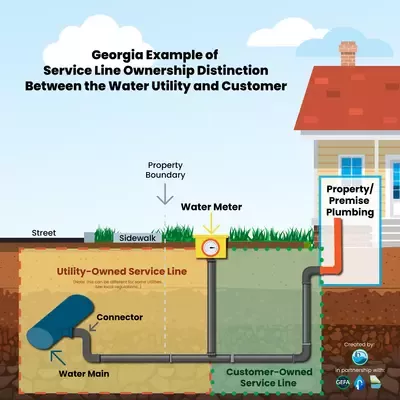
What is a water service line?
A service line is the piping that runs from the water main to the building inlet. Ownership varies by water system but is typically split between the water system and the customer. The City of Mountain Park owns the section of the service line from the water main to the water meter box, while the section from the water meter box to the home is owned by the customer.
What are water service lines made from?
Over the years, various materials have been used to manufacture water service lines, including galvanized steel, copper, and plastic. Prior to 1990, some service lines in Georgia may have contained lead, which can have negative health impacts if it enters the water through corrosion of plumbing materials.
Water Service Line Inventory
The City of Mountain Park water system is hard at work on the Water Service Line Inventory. Identifying service line pipe material for each metered water connection is required of all systems by the EPD. You may receive a notification via mail regarding the water service line at your address. Be sure you stay connected and have your contact information updated for your water account with Mountain Park to receive information provided by the water system.
Will I be notified of my water service line material?
Customers will receive a notification letter if their water service line material is determined to be lead or galvanized steel or if their water service line material is unknown. If you do not receive a notification letter by December 1, 2024 indicating otherwise, then it has been determined that your site has no lead or galvanized water service lines (including the customer-owned water service line from the meter to the home).
What are the health effects of lead?
Exposure to lead in drinking water can cause serious health effects in all age groups. Infants and children can have decreases in IQ and attention span. Lead exposure can lead to new learning and behavior problems or exacerbate existing learning and behavior problems. The children of women who are exposed to lead before or during pregnancy can have increased risk of these adverse health effects. Adults can have increased risks of heart disease, high blood pressure, kidney, or nervous system problems.
What can I do to reduce exposure to lead in drinking water?
- Run your water to flush out lead. If the water hasn’t been used for several hours, run the water for 15-30 seconds to flush lead from interior plumbing or run it until it becomes cold or reaches a steady temperature before using it for drinking or cooking.
- Use cold water for cooking and preparing baby formula.
- Do NOT boil water to attempt to remove lead.
- Look for alternative sources or treatment of water (such as bottled water or water filters).
- Re-test your water for lead periodically.
- Identify and replace plumbing fixtures containing lead.
For more information on reducing lead exposure around your home and the health effects of lead, visit EPA's website at https://www.epa.gov/lead or contact your health care provider. To learn more about the results of our water testing, please review our annual Water Quality Report.